In this article, we’re diving into the recent enhancements within Geodesignhub projects. At its core, the fundamental value proposition of Geodesignhub is to enable diverse stakeholders with competing interests to collaborate and build a consensus-based, common baseline. However, moving from individual designs to a single, unified agreement is often the most challenging phase of any project.
To make this transition smoother and more structured, we are excited to introduce our new Negotiation Strategy view now available when comparing two designs.
Who negotiates → How to Negotiate
In typical Geodesignhub workflows, multiple teams build design syntheses simultaneously. Once these designs are ready, we normally conduct a sociogram exercise. The sociogram is a powerful diagnostic tool that helps us identify which two teams are closest in alignment and should negotiate to combine their designs.
But knowing who should negotiate is only half the battle; setting up the step-by-step framework for how they negotiate is where projects succeed or stall. This is where the new Negotiation Strategy feature steps in, turning complex spatial negotiations into a structured, manageable sequence.
The Negotiation flow
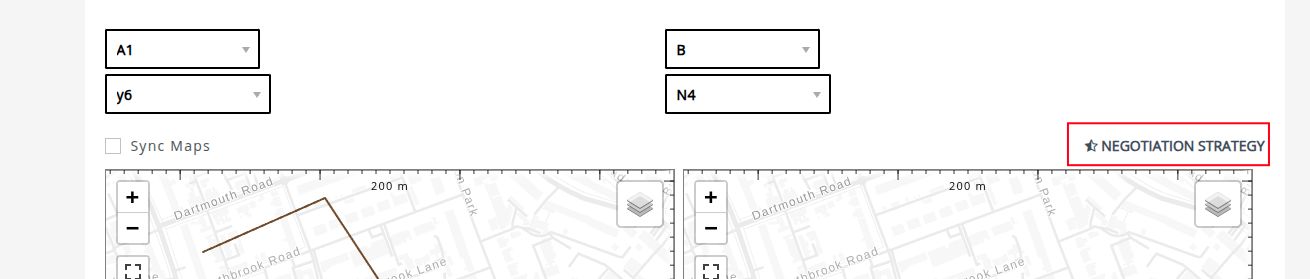
When you compare two syntheses in the “Compare two syntheses” interface, you will now see a dedicated Negotiation Strategy button in the top-right corner.
Clicking this button triggers a real-time spatial and textual analysis of the two compared designs, evaluating both their project areas and text descriptions. (below)
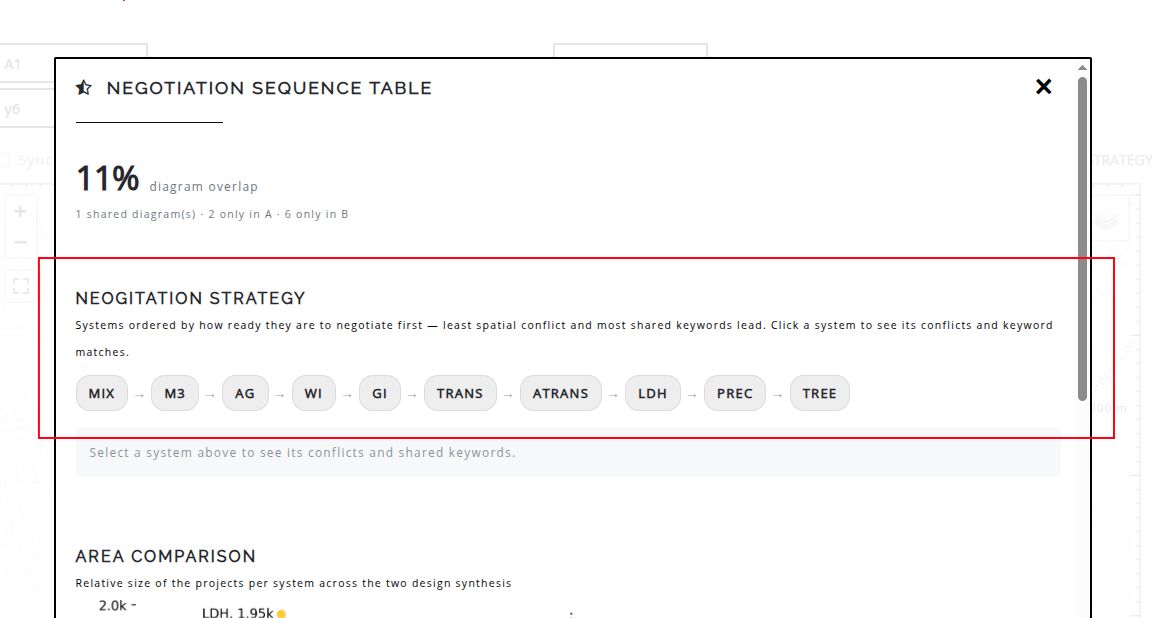
Instead of forcing teams to tackle their biggest disagreements first—which often leads to early gridlock—the system generates a sequential negotiation roadmap.
The algorithm analyzes the designs and orders the systems from least contentious to most contentious. Systems with the least spatial conflict and the highest amount of shared keywords are placed at the front of the queue.
By starting with these “easy wins,” teams quickly establish a shared baseline of agreement, building the psychological momentum and trust needed to tackle tougher, high-conflict systems later in the sequence.
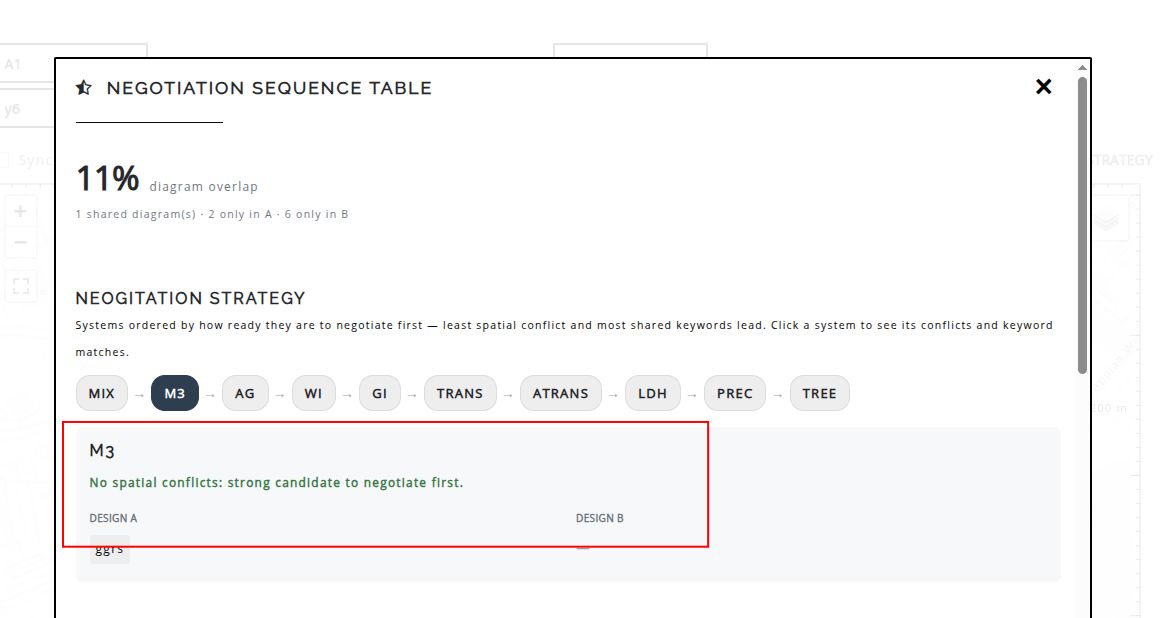
When you click on any system in the sequence, the interface instantly highlights its status, pointing out areas with no spatial conflicts that serve as ideal starting points.
For every step of the sequential negotiation, teams look at the diagrams being “exchanged” system-by-system.
Decision making
To keep the process highly focused and action-oriented, negotiators only have to make one of three decisions for each diagram:
-
Keep it as is: Accept the diagram into the combined design without changes.
-
Drop it from the design: Mutually agree to remove the diagram entirely.
-
Modify it: Change its size or geographic location, and save it as a brand-new diagram.
By breaking down a massive, overwhelming spatial negotiation into a series of bite-sized, system-by-system micro-decisions, the Negotiation Strategy view removes the friction from collaborative planning. It turns what used to be an unstructured debate into an objective, data-driven path to consensus.
Try out the new view in your current Geodesignhub projects, and let us know how it changes your negotiation dynamics in the comments below!